

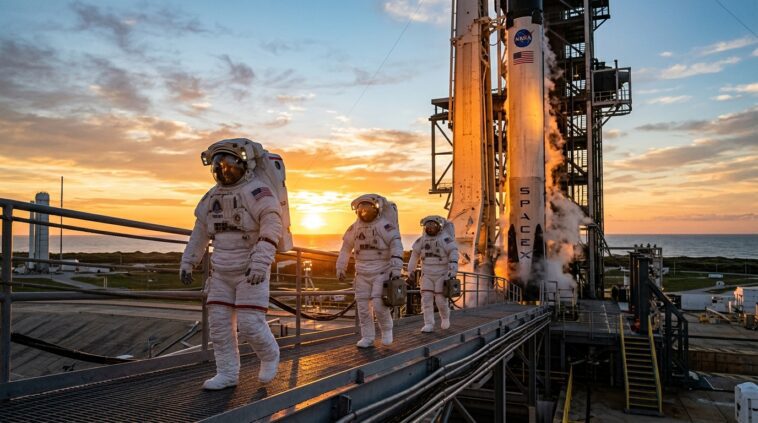
While millions watched Artemis II streak toward the moon, one crew member’s children asked a question no NASA briefing could answer: “Daddy, why does the sky have fire in it?”
Commander Reid Wiseman’s family was in the viewing area at Kennedy Space Center when the SLS rocket ignited. His two kids, still young enough to think bedtime is negotiable, had spent the morning running between a foam model of the Orion capsule and a cardboard cutout of their father in a pressure suit. They didn’t fully understand where dad was going. They just knew he’d be gone for more than a week.
What It Feels Like to Watch Someone You Love Disappear Into the Sky
The launch footage went viral for good reason. A Delta Airlines flight from Atlanta to Los Angeles happened to pass directly through the rocket’s trajectory at 37,000 feet. Passengers pulled out their phones and filmed. One video, shot through an airplane window showing the rocket’s exhaust plume arcing across a sunset sky, racked up 80 million views in 48 hours. Social media users called it “the most cinematic launch ever witnessed from Earth.”
But step off the screen and away from the hashtags, and the human moment was more raw than cinematic. Families of the four Artemis II crew members — Wiseman, Victor Glover, Christina Koch, and Jeremy Hansen — had spent years watching their loved ones train, certify, and prepare to go further than any human since 1972.
For Glover’s kids, the moon isn’t abstract. They’ve grown up watching their father log hundreds of hours aboard the International Space Station. They know what weightlessness does to a PB&J sandwich. They know the particular sound a spacesuit makes when the oxygen hose clicks loose.
The Science Is Extraordinary. The Homesickness Is Ordinary.
NASA’s mission control in Houston will track every orbital parameter, radiation reading, and life support metric. What they won’t track is the specific ache of a ten-year-old missing her dad so much her stomach hurts, or the way a spouse double-checks the locked front door three times a night because her brain is running on fear fumes.
Artemis II is a test flight, not a moon landing. The crew will orbit the moon — not touch down — before returning to Earth. But even that “short” trip means ten days in a spacecraft smaller than a studio apartment, with recycled air and a view no human filter can fully process.
The real story isn’t the physics. It’s that four humans voluntarily locked themselves inside a controlled explosion aimed at a rock 240,000 miles away, and the rest of us held our breath.
Why This Changes Everything for Regular People and Space Tourism
Here’s what the viral videos missed: the launch of Artemis II signals the opening of a new era where space isn’t just for career astronauts anymore. The Artemis program is laying the groundwork for a sustained lunar presence, and eventually, commercial flights to the moon.
NASA has already signed contracts with Axiom Space and Collins Aerospace to develop private space station modules and next-generation spacesuits. SpaceX’s Starship, which will eventually land astronauts on the lunar surface for Artemis III, is being marketed to private customers for the late 2020s.
The airplane passenger who filmed that viral video from 37,000 feet wasn’t a professional videographer. She was a sales manager from Charlotte on her way to a conference. She didn’t plan to witness history. She just happened to be in the right seat at the right time.
That’s the future Artemis is building toward: a world where space isn’t a government exclusive, but a place regular people might actually visit.
The Road Ahead for Artemis III and Beyond
Artemis II is the bridge. The real milestone comes with Artemis III, which will put the first woman and first person of color on the lunar surface. After that, NASA’s Gateway platform — a small space station orbiting the moon — becomes the jumping-off point for extended missions.
The long-term goal isn’t flags and footprints. It’s establishing infrastructure: habitats, mining operations, and eventually, a tourism economy. The moon a decade from now might look less like a government research facility and more like Antarctica — remote, expensive, and alluring precisely because most people can’t go.
For now, though, there’s just the Wiseman kids asking about fire in the sky, and a father who’s too busy orbiting the moon to explain it.
GIPHY App Key not set. Please check settings