

Maria Delgado is not a legal scholar. She’s a dental hygienist from El Paso who speaks to her patients about plaque buildup and gum disease, not constitutional amendments. But in January 2025, she woke up to find her six-year-old daughter Lily’s birth certificate had been called into question by a presidential executive order — and suddenly, she had to learn what the 14th Amendment actually says.
“Lily was born in El Paso. She’s Texan. She’s American,” Delgado said in a phone interview, her voice tight. “Now I’m supposed to prove it? I’ve been a citizen my whole life and I’ve never had to prove anything.”
What the 14th Amendment Actually Says (And Why It’s Being Challenged)
The 14th Amendment, ratified in 1868 after the Civil War, contains 26 words that have defined American citizenship for over a century: “All persons born or naturalized in the United States… are citizens of the United States.”
Those words ended decades of legal debate about whether formerly enslaved people could be citizens. They also established what’s come to be called “birthright citizenship” — the principle that anyone born on American soil is automatically a citizen, regardless of their parents’ nationality.
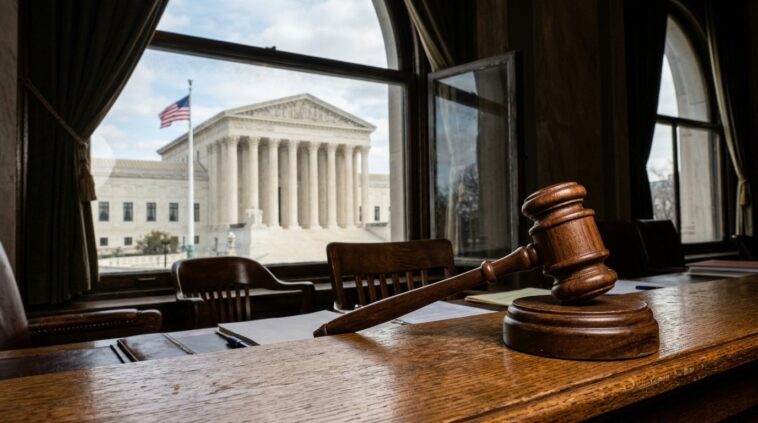
The current Supreme Court challenge stems from an executive order attempting to restrict citizenship for children born to parents who are not legal permanent residents. During oral arguments, the Court’s conservative justices appeared deeply skeptical of the administration’s position. Chief Justice John Roberts pressed the administration’s lawyer on whether the Constitution’s language supported the order’s interpretation. Justice Amy Coney Barrett asked pointed questions about what would happen to children who had no control over their parents’ immigration status.
The courtroom gallery included an unusual observer: former President Trump, who had issued the original order, sat quietly in the front row watching attorneys argue over the policy he championed.
The Human Cost of Legal Uncertainty
For families like the Delgados, the legal arguments translate into real-world anxiety. Maria’s husband, Carlos, is a legal permanent resident. Their older sons, born in the US, have never faced questions about their citizenship. But Lily — born two months after Carlos’s green card renewal was caught in a processing backlog — became a symbol in a debate she doesn’t understand.
She’s in first grade. She knows how to spell her name, ride a bike without training wheels, and recite the pledge of allegiance at school. She does not know that the Supreme Court of the United States is deciding whether she is American.
Immigration lawyers across the country report a surge in inquiries from terrified parents. Many assumed birthright citizenship was settled law. Many are learning, like Maria Delgado, that “settled” can be undone by one court decision.
What the Supreme Court Might Decide — and Why It Matters
Based on the oral arguments, legal analysts believe the Court is likely to rule the executive order unconstitutional — but the margin and the reasoning remain unclear. Several justices seemed concerned about the administrative chaos that would follow a ruling in the administration’s favor.
If the Court upholds birthright citizenship, the 14th Amendment stands as written, and the debate moves back to Congress, where comprehensive immigration reform has stalled for decades.
If the Court narrows or restricts birthright citizenship, the implications would be enormous. An estimated 300,000 to 400,000 children are born annually to parents who are not US citizens or permanent residents. Many of those children would face a two-tiered citizenship system, with different rights based on their parents’ legal status.
For Maria Delgado, the constitutional abstractions collapse into something very simple. “I don’t care about the amendment,” she said. “I care that my daughter can go to school, get a passport, apply for a job someday without someone telling her she’s not really one of us.”
The Supreme Court is expected to issue its decision by June. Until then, Maria will keep taking Lily to school, keep packing her lunch, and keep believing that being American means more than a piece of paper.
GIPHY App Key not set. Please check settings