

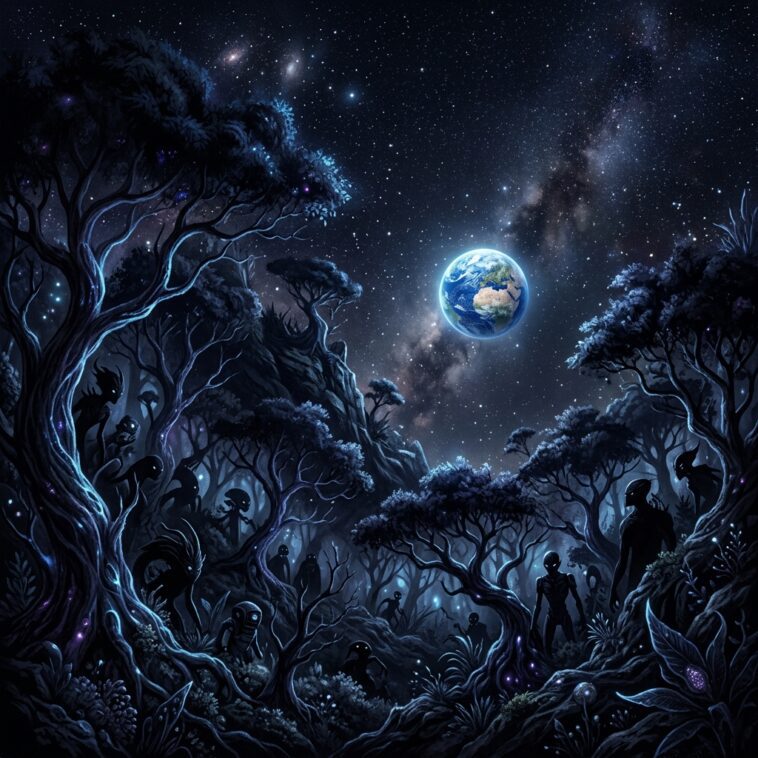
The universe is impossibly vast. There are billions of galaxies, each containing billions of stars—and around many of those stars, planets orbit in the habitable zone where liquid water might exist. Statistically speaking, intelligent life should almost certainly exist elsewhere. So why has humanity heard nothing but silence across the cosmos? No transmissions, no signals, no evidence that anyone is out there at all.
This dilemma is called the Fermi Paradox, named after physicist Enrico Fermi, who reportedly asked “Where is everybody?” during a lunch conversation in 1950. It’s one of the most profound questions in science—and one of its most unsettling proposed answers is called the Dark Forest Hypothesis.
The Dark Forest Hypothesis: A Chilling Idea
The concept is straightforward and deeply unsettling: the universe is full of intelligent civilizations, but they’re all staying quiet. Hiding. The reason is survival—any civilization that reveals itself risks drawing the attention of a more advanced, potentially hostile neighbor that might strike first and ask questions later.
The name comes from Chinese science fiction author Liu Cixin’s novel The Dark Forest (2008), the second book in his Hugo Award-winning trilogy. But similar ideas existed before Liu’s work. The core logic has been described as a cosmic prisoner’s dilemma: you can’t know another civilization’s intentions, you can’t communicate without potentially giving away your location, and if there’s even a small chance they’re hostile, the rational move is to eliminate them before they do the same to you.
As Liu Cixin wrote in the novel: “The universe is a dark forest. Every civilization is an armed hunter stalking through the trees like a ghost, gently pushing aside branches that block the path and trying to tread without sound. In the forest, he hunts, stalks, breathes, listens. Everything that主人的 other existence is an铁矿. He has to be careful, because everywhere in the forest are hunters like himself.”
The Game Theory at Its Core
What makes the Dark Forest Hypothesis so compelling from a logical standpoint is that it doesn’t require assuming alien civilizations are evil. It just assumes they’re rational—and in a universe where you don’t know who you’re dealing with, rationality dictates caution. If two civilizations meet and one is more advanced, the advanced one has every incentive to eliminate the less advanced one before the reverse becomes possible. The less advanced civilization, knowing this, has every incentive to stay hidden.
Even if 99% of civilizations are peaceful, the 1% that aren’t would quickly dominate. Any group that adopted a different strategy—broadcasting its location, reaching out—would be wiped out. Over millions of years, what remains in the forest are only the quiet ones, too scared to make a sound.
Why SETI Hasn’t Found Anything
The Search for Extraterrestrial Intelligence (SETI) has spent decades listening for radio signals from space. The Dark Forest Hypothesis suggests that’s exactly why we won’t find anything—because the smart move for any civilization is to NOT transmit. Broadcasting your location to the cosmos is essentially painting a target on yourself.
The hypothesis also carries an uncomfortable implication for humanity: we’ve already made ourselves known. Humanity has been leaking radio signals into space for over a century—TV broadcasts, cell towers, satellite communications. Any civilization with sufficiently advanced technology within about 100 light-years could theoretically detect us. If the forest is full of hunters, they already know we’re here.
Problems With the Theory
Critics have pushed back on the hypothesis from multiple angles. It assumes all advanced civilizations are hostile—which isn’t necessarily true. It assumes hiding is sustainable—but even advanced stealth technology can’t fully mask a civilization’s existence forever, especially as it consumes energy and resources. Some scientists also point out that if the Dark Forest dynamic truly governed the galaxy, we’d expect to see some evidence of destructive cosmic conflicts—which we haven’t.
There’s also the question of cooperation. On Earth, we’ve seen civilizations form alliances and trade networks rather than simply annihilate each other on sight. Why would the cosmic dynamic be so fundamentally different? The prisoner’s dilemma has cooperative equilibria too—it assumes no communication or trust, but over cosmic timescales, couldn’t trust develop?
The Uncomfortable Truth It Forces Us to Face
Whether you find the Dark Forest Hypothesis convincing or too grim to be realistic, it serves a valuable purpose: it forces us to confront the Fermi Paradox head-on rather than dismissing it. The silence from space isn’t easily explained by “they’re too far away” or “they don’t exist.” There are billions of years’ worth of stars older than our sun. If intelligent life were common, it seems statistically inevitable that at least some civilizations would have colonized the galaxy by now.
What if the silence isn’t because aliens don’t exist—but because the ones that do exist are too smart to say hello? That might be the most sobering realization in all of cosmology. And it raises an even darker question: are we already marked?
GIPHY App Key not set. Please check settings