

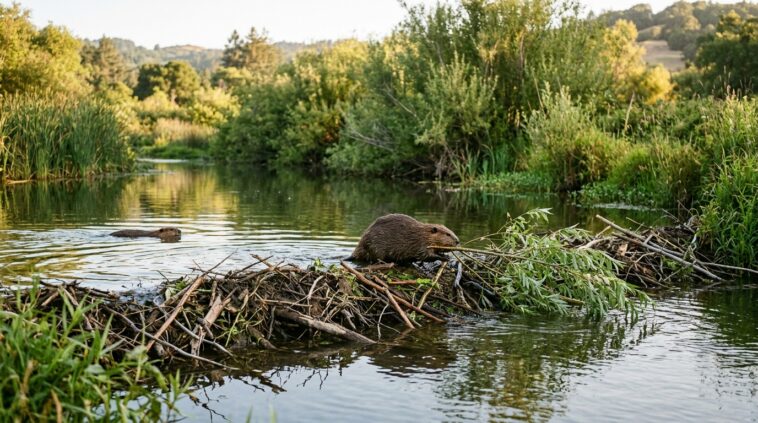
Nobody told the beavers California needed saving. They just showed up — again — and started doing what they do best: building dams, creating ponds, and accidentally solving problems humans have spent billions trying to fix.
After 70 years of absence, beavers have returned to parts of California through a coordinated reintroduction program, and the results are making wildlife biologists use words like “stunning” and “beyond our projections.” This isn’t just a wildlife win. It’s an ecological reversal that touches water, fire, and fish.
The Unexpected Wetland Engineers
Beavers are basically construction workers with no architecture degree and unlimited ambition. They don’t plan wetlands — they build dams, the dams create ponds, the ponds slowly become marshland, and the marshland becomes meadow as water spreads and vegetation changes over seasons.
What does that mean for California? A state that lost 95% of its historical wetlands now has pockets of active restoration happening without a single dollar of maintenance cost. “We built one experimental pond and a family of beavers expanded it into six interconnected wetlands in eighteen months,” says Dr. Sarah Chen, a wildlife biologist with the California Department of Fish and Wildlife. “That’s $2 million worth of ecosystem services we didn’t have to pay for.”
Firefighters With Fur
Here’s the number nobody in California wants to ignore: beaver-created wetlands hold water long after surface rivers run dry. In a state where wildfire season keeps getting longer, that underground reservoir matters.
Research from fire ecology labs shows that landscapes modified by beaver activity burn 60% less intensely than adjacent untreated areas. The water stored in their ponds and the moisture retained in surrounding vegetation creates natural firebreaks. It’s not prevention — but it’s meaningful reduction in spread and intensity.
Dr. Chen puts it bluntly: “We’re spending money to fight fires. Beavers are spending sticks and mud to prevent them. The math isn’t complicated.”
The Salmon Comeback Nobody Announced
Salmon populations in California have collapsed over decades of habitat loss. Rivers were straightened, banks were hardened, water was diverted. The fish had nowhere to spawn, no shallow water for juveniles to grow, no cool pools to survive summer heat.
Beavers create exactly what salmon need. Slow, shallow water with complex structure — roots, branches, undercut banks. Juvenile salmon thrive in these spaces, and they’re insulated from predators. Early monitoring data from reintroduction sites shows juvenile salmon densities up 300% in beaver-adjacent pools compared to untreated river sections.
It’s not just salmon. Crayfish, frogs, songbirds, otters — the biodiversity cascade from a single beaver family is remarkable to watch. Dr. Chen describes monitoring one site where she counted 47 bird species in a single morning. “This is what California looked like before we decided we didn’t need beavers.”
What California Figured Out
The reintroduction program started cautiously — trapping beavers from populations in Nevada and Oregon and relocating them to protected watersheds. Initial concerns focused on potential conflicts with agriculture and infrastructure. Beavers, after all, don’t read property lines.
The solution was surprisingly low-tech: tree protection devices and flow devices that prevent dam buildup near roads. Human management, beaver engineering. The conflict hasn’t disappeared, but it’s manageable in ways it wasn’t when beavers were seen purely as pests.
What California discovered is that removing beavers created problems. Returning them solved several at once — problems that had no affordable technical solution. Wetland restoration projects cost millions and require perpetual maintenance. A beaver family charges nothing and maintains itself.
The state doesn’t need more money. It needed more beavers. Sometimes the old engineers are the best ones for the job.
GIPHY App Key not set. Please check settings