

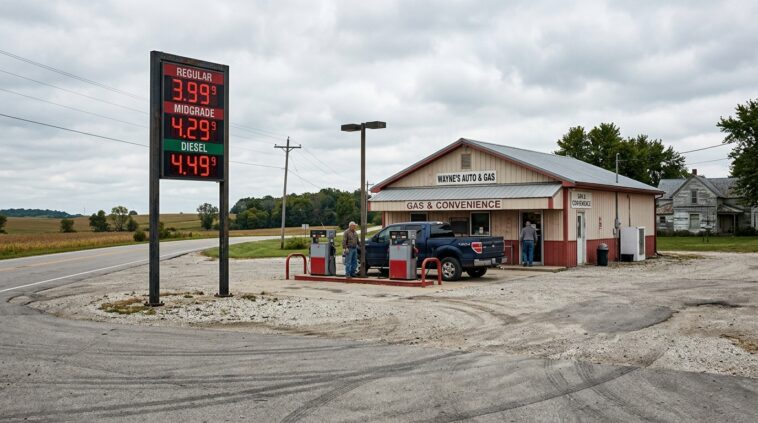
The sign at Big Ernie’s Exxon in rural Virginia used to read $3.42 a gallon. Today it reads $4.89. And Ernie Malik is losing sleep over it.
“I can’t raise prices fast enough to keep up,” he says. “My suppliers are charging me more every week, but my customers — they’re already stretching every dollar. Raise the price another 30 cents and they stop buying. Don’t raise it and I’m underwater on every tank.”
Malik’s predicament captures the human reality behind the Iran conflict’s economic ripple effect. While cable news debates troop movements and diplomatic maneuvering, a different kind of American family is getting squeezed at the pump.
The Trucker Who Can’t Afford to Drive
Mike Kowalski has been hauling freight from Jacksonville to Chicago for 22 years. His route takes him through some of the most fuel-intensive terrain in the country, and diesel costs have always been his biggest expense after his truck payment.
Last month, he spent $8,200 on diesel. This month, his projections put him at $11,400 — before he can even move a single load of consumer goods.
“I gotta pass those costs on somehow,” Kowalski says. “But my customers are telling me they’ll find another hauler if I raise rates. They’re not wrong. The margins were already thin.”
He’s not alone. The American Trucking Associations estimates that fuel costs now consume 35-40% of operating budgets for independent owner-operators, up from 25% just six months ago.
What This Means for the Food on Your Table
Here’s the thing most people don’t realize: every time diesel goes up a dollar per gallon, it adds roughly $500 to the cost of shipping a standard 53-foot trailer of groceries across the country. That cost doesn’t disappear. It gets added to the price of everything from cereal to chicken.
The average American family could see grocery bills rise $200-400 per month if oil prices stay elevated, according to estimates from farm bureau economists across the Midwest.
The Small Business Owner Stuck in the Middle
In Columbus, Ohio, restaurant owner Maria Santos has already raised her menu prices twice this year. Her suppliers have told her to expect another price bump in 30 days — everything from cooking oil to chicken to paper containers.
“I can either raise prices again and lose customers, or I can eat the costs and lose my business,” she says. “There is no third option.”
Her 60-seat restaurant employs 14 people. If she closes, that’s 14 families who lose income. If she raises prices again, her mostly working-class clientele might stop coming anyway.
You see the bind? You really do find yourself asking — who wins in a crisis like this? Because from where I’m sitting, it seems like everybody’s just trying not to fall behind.
The Families Feeling It Most
For Malik, the gas station owner, the human toll is personal. He knows most of his customers by name. He knows which ones are filling up before payday, counting out quarters in the office.
“That family with three kids who buys $20 worth of gas every week so dad can get to work — they’re the ones getting hurt most,” he says. “Not the people watching from their living rooms. The people actually living it.”
The Iran conflict feels distant when you’re reading about it on your phone. But for millions of Americans, the impact is immediate, tangible, and arriving at their local gas stations, grocery stores, and small businesses right now.
GIPHY App Key not set. Please check settings