

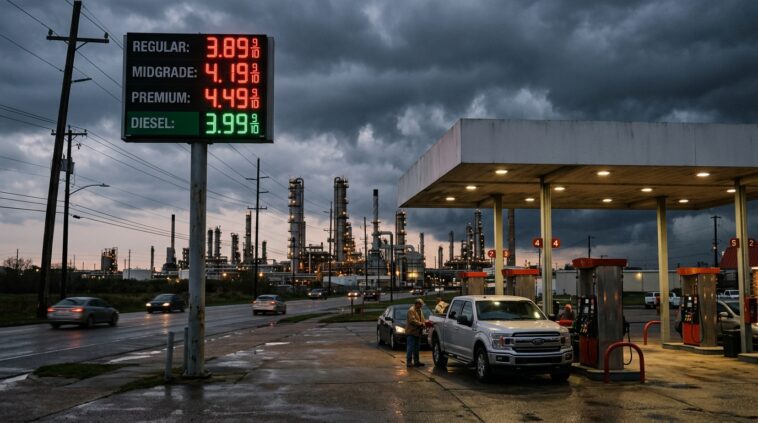
The missiles started flying six weeks ago. Most Americans watched the news from their couches, shook their heads, and moved on with their day. But something strange happened at the gas station three days later — prices ticked up eight cents overnight. Then twelve more. Now, a gallon of regular sits at levels nobody predicted heading into spring.
This isn’t just a story about geopolitics. It’s a story about the $94 Costco run that used to be $71, the Thanksgiving turkey that costs more because feed companies pay higher transport rates, and the heating bill you’re going to stare at in October wondering what happened.
The Strait of Hormuz Problem Nobody Talks About
Here’s the thing: roughly 20% of the world’s oil passes through the Strait of Hormuz. That’s not a talking point — it’s the actual artery of global energy. When Iran starts making threats about that waterway, tankers get rerouted. Insurance premiums jump. Traders panic-buy. And all of that friction costs money.
Where does that money come from? Your pocket.
Dr. Marcus Webb, an energy economist at Columbia University’s Center on Global Energy Policy, puts it plainly: “The consumer doesn’t see the Strait of Hormuz on their receipt. But they’re paying for it every single time they fill up.” His research shows that even low-level geopolitical tension in the Gulf region translates to a 3-7% premium on retail gasoline within 10 days.
So what actually happens when strikes enter their sixth week? The market isn’t just reacting to what’s happening now — it’s pricing in what might happen next. That’s called risk premium, and right now it’s high.
From the Pump to the Grocery Aisle
Most people think oil prices only matter at the gas station. That’s naive. Everything on a grocery shelf traveled there on a truck. Those trucks run on diesel. When diesel costs more, stores pass the expense along — not immediately, but within months. That’s the lag effect nobody discusses.
Agricultural economists tracking the conflict say corn, soy, and wheat futures have already shifted upward. Why? Because farmers rely on fuel for tractors, fertilizer transport, and processing facilities. The math is brutal and simple: higher fuel costs compress margins, and somebody absorbs that loss.
It isn’t always the farmer. Sometimes it’s the food company. Sometimes it’s the grocery chain. Eventually, it’s you.
The Ripple Nobody Expects
Here’s what keeps energy analysts up at night: the petrochemical industry. Plastic packaging, synthetic fabrics, even some medications depend on oil-derived precursors. A sustained spike doesn’t just make gas expensive — it makes everyday products cost more across the board.
The average American family could see $200-400 in additional monthly expenses if current conditions persist through summer, according to estimates from the National Energy Assistance Directors Association. That’s not noise. That’s a car payment. That’s a week of groceries.
What Experts Say You Can Actually Do
Dr. Webb cautions against panic buying or changing habits based on weekly fluctuations. “Oil markets are volatile by nature. The six-week timeline is significant, but we haven’t hit sustained crisis territory yet.” He recommends families use this moment to review their transportation budgets, consolidate errands, and resist the urge to trade in a fuel-efficient car for an SUV just because gas feels manageable right now.
For longer-term planning, analysts point to hybrid or electric vehicle consideration — not as politics, but as financial strategy. The math on total cost of ownership has shifted dramatically in the last 18 months, conflict or no conflict.
The missiles may stop someday. The market won’t forget. Prices don’t simply snap back — they drift, adjusting to new realities beneath the headlines.
Six weeks of strikes changed the calculus. The question now is whether your family’s budget was paying attention.
GIPHY App Key not set. Please check settings