

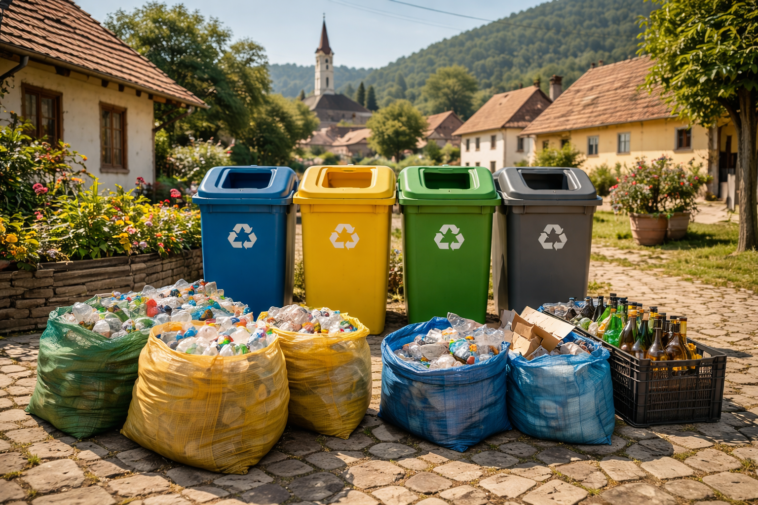
Nobody expected Romania to become a sustainability role model. The country has its share of problems — political corruption, economic emigration, crumbling infrastructure. But somewhere between the EU accession in 2007 and today, something unexpected happened. Romania started getting serious about waste. And it started at the ground level, in places that do not typically make international headlines.
How did a nation that barely recycled 5% of its municipal waste in 2010 now operate some of the most innovative community recycling programs in Eastern Europe? The answer involves stubborn mayors, EU funding, and a cultural shift that nobody planned.
The Numbers That Shocked the System
In 2015, Romania recycled just 13% of its collected waste. The EU average was 44%. Landfills were overflowing — literally. The Glina landfill outside Bucharest made international news when it collapsed in 2015, killing three people and burying homes under garbage. It was a turning point, though few recognized it at the time.
The scandal forced politicians to act. But the real change came from an unlikely source: small-town mayors who had visited Austria and Germany and seen what selective waste collection actually looked like. They came home with photos, pamphlets, and an idea that their constituents thought was crazy.
People laughed at first, says Ionut Popescu, mayor of Sighisoara since 2016. They had never separated their garbage in their lives. But we started small. One color bin. Free distribution. And we just kept asking people to try.
The Infrastructure Nobody Talks About
Technology alone does not solve recycling. Anyone who has visited a country with beautiful recycling bins and full landfills knows this. The missing piece is often behavioral infrastructure — the habits, social norms, and community accountability that make separation feel worthwhile.
Romania breakthrough was deploying recycling promoters — local residents, often retirees or young parents, who volunteered to staff collection points and educate neighbors. They were not government employees. They were not lecturing anyone. They were just present, consistently, until sorting started feeling normal.
Some villages turned it into competition. Which neighborhood could achieve the highest participation rate? Winners got their street cleaning prioritized for the month. It sounds trivial, but community pride is a powerful motivator.
EU cohesion funds covered the capital costs — trucks, sorting facilities, bins. But the social infrastructure, the part that actually changes behavior? That came from Romanians convincing other Romanians.
The Numbers That Actually Matter
By 2023, Romania municipal recycling rate hit 38%. Not world-leading, but a tripling in eight years. More importantly, separate collection coverage expanded from 10% of municipalities to over 60%. The trajectory matters more than the absolute number.
Critics point out that Romania still sends more waste to landfills than it should. That is fair. The country waste management infrastructure still lags Western European standards. But the direction has flipped — and that shift in momentum is harder to achieve than it looks.
Cluj-Napoca, the tech hub of Transylvania, now operates one of Eastern Europe most sophisticated separate collection systems. Its waste management company won a European Award for Sustainability in 2024. When journalists ask how, officials give the same answer: we copied what worked elsewhere, then adapted it for here.
What Other Countries Keep Getting Wrong
The standard approach to improving recycling rates in developing or transitional economies follows a predictable pattern: build facilities, mandate sorting, punish non-compliance. It is the model the EU pushed for years. It produces results, technically. But it also produces resentment.
Romania village-level approach worked precisely because it avoided the top-down lecture. Nobody told farmers they were bad environmentalists. Nobody threatened fines before habits took hold. Instead, communities were invited to participate in something that felt like theirs.
That distinction — between compliance and commitment — explains why some programs succeed and others plateau. Romania is not finished. Its system still needs investment, monitoring, and political will to sustain. But the foundation is genuine. And that is harder to knock down than a recycling bin.
Maybe the lesson is not that Romania solved a crisis. Maybe it is that solutions take root when people build them themselves.
GIPHY App Key not set. Please check settings