

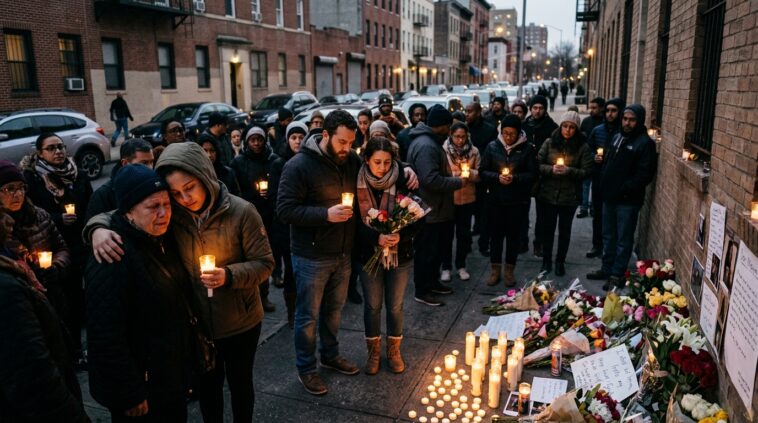
The morning after the shooting, someone had already laid flowers at the exact spot where the stroller had been. Pink and white carnations, a stuffed teddy bear with a ribbon, and a handwritten note that read: “You never got to see the ocean.”
The killing of a 7-month-old baby in a Brooklyn stroller on a Tuesday afternoon didn’t just make headlines. It cracked something open in the Canarsie neighborhood — a place where neighbors wave to each other, where the same families have lived for three generations, and where gun violence had always felt like something that happened somewhere else.
The Night the Community Decided to Stop Waiting
Within 48 hours of the shooting, a community meeting drew 400 people to the local YMCA. It wasn’t organized by any official advocacy group. It was organized by a 23-year-old nursing student named Destiny Morgan, who posted a call to action on Instagram and watched it spread faster than any local news broadcast.
“People were tired of showing up to vigils,” Morgan said. “Tired of lighting candles and saying ‘never again’ and then going home. I wanted to walk out of that room with an actual plan.”
The room broke into working groups: one focused on pushing the city council for surveillance cameras on the block where the shooting happened, another on connecting families with violence interruption programs, another on organizing a citywide rally.
The Survivors Who Didn’t Make the News
The baby’s mother, who has asked not to be publicly identified to protect her privacy, was physically unharmed. She was standing at the corner of Remsen Avenue and Glenwood Road when the bullet struck her daughter’s stroller. She screamed. Witnesses say she didn’t stop screaming for several minutes.
She is not a public figure. She has not given interviews. But community members who know her say she’s been receiving calls from city officials, offers of counseling, and — in one instance she described as “sickening” — a request from a political consultant asking if she’d be willing to appear in a campaign ad.
She declined.
Other survivors of the block’s recent gun violence have been more vocal. A 19-year-old named DeShawn Williams was shot in the same intersection three months ago. He survived. He came to the community meeting on crutches.
“I was the one they wrote a paragraph about,” he told the room. “She was a baby. Her story is the one that matters now. But I want everyone here to know — I’m still here. And I’m angry that it took a baby dying for anyone to listen.”
A New Policy Proposal That Doesn’t Wait for Albany
City Councilmember Inez Barron, whose district includes Canarsie, announced at the meeting that she would introduce a package of legislation focused on interceptive gun violence prevention — specifically, expanding the city’s crisis intervention teams to operate in the 83rd precinct around the clock.
The bill has a narrow scope. It would fund additional training for police officers in de-escalation tactics and create a grant program for community organizations running violence interruption programs in high-incident zones.
It’s not a comprehensive gun control measure. It doesn’t address the broader state or federal debate. It’s a targeted, local, implementable policy that could have a direct impact on the block where a seven-month-old girl died in a stroller.
The challenge: the city budget cycle means any new spending needs to be voted on by July. The community coalition has three months to build enough public pressure to make the bill impossible to ignore.
The Harder Conversation Nobody Wants to Have
Beyond the policy fight, organizers in Canarsie are grappling with something harder: how does a neighborhood heal when the shooter is still unidentified?
NYPD detectives have released security footage showing a dark-colored sedan leaving the scene. No arrests have been made. The department’s 67th Precinct has offered a $25,000 reward for information leading to an arrest.
Without an arrest, closure feels impossible. Without a name attached to the crime, grief becomes harder to process — it’s diffuse, shapeless, directed at a phantom.
Destiny Morgan knows this. She’s planning the rally for this Saturday. She’s coordinating with three other neighborhoods that have experienced similar losses in the past two years.
“We’re not going to let them tell us this is just a Brooklyn story,” she said. “We’re not going to let them tell us this is just a gang thing, or a poverty thing, or a this-thing or a that-thing. A baby died in a stroller. We should be able to agree that shouldn’t happen anywhere.”
The flowers are still at the corner. Someone replaces them every day.
GIPHY App Key not set. Please check settings